
Table of Contents
- What Non-Toxic Really Means for Slime
- Step 1: Read the Label and Check for Warning Signs
- Slime Ingredients to Avoid
- Is Slime Safe for Kids: Age-Specific Guidance
- Homemade Slime Safety: DIY Recipes and Risks
- Slime Mold and Storage: Keeping Slime Safe Over Time
- What to Do If a Child Is Exposed to Unsafe Slime
- Frequently Asked Questions
Last Updated: October 19, 2026
What Non-Toxic Really Means for Slime
Non-toxic slime is formulated without harmful chemicals that pose health risks to children through skin contact, ingestion, or inhalation.
Non-toxic slime should be free from boron compounds, heavy metals, and synthetic chemicals linked to developmental harm, and made from recognizable ingredients: water, cornstarch, food coloring, and child-safe glues.
The key difference between safe and unsafe slime comes down to one thing: the ingredient list. If you cannot find one, that's your first red flag.
Step 1: Read the Label and Check for Warning Signs
The first step in learning how to tell if slime is non toxic is to read the package in a fixed order, the front is marketing, the back is where disclosures live.
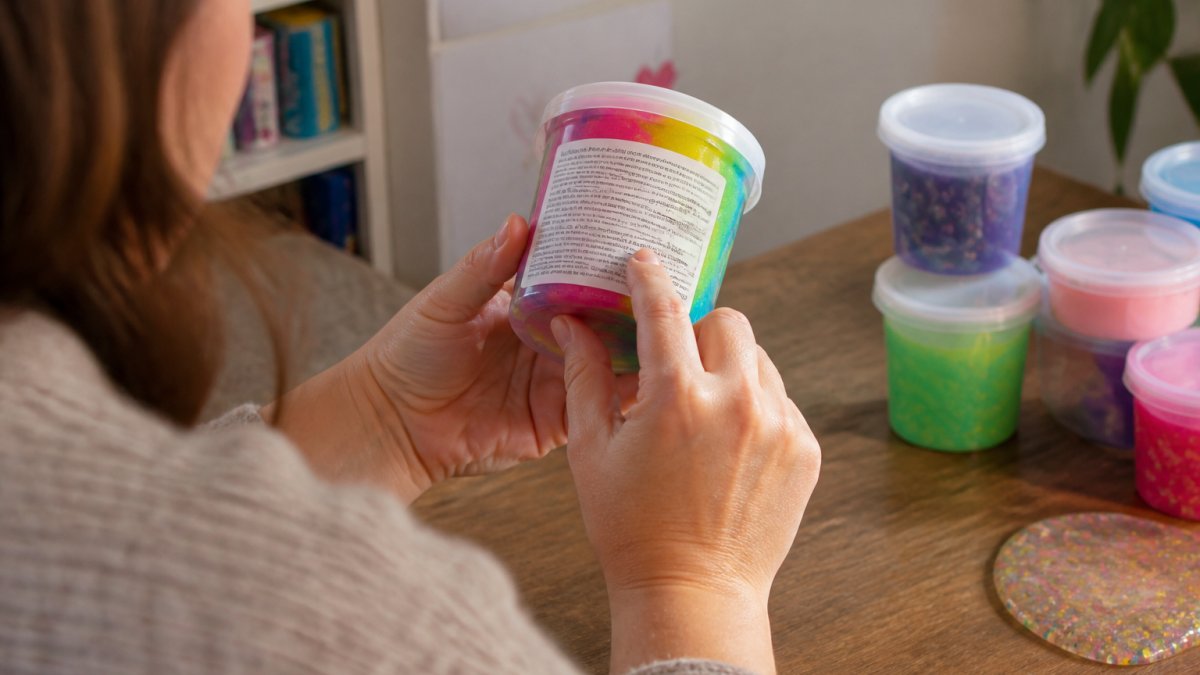
The Label-Reading Checklist
Work through these six checks in order, and reconsider the product if any check fails.
- Find the full ingredient list, not just the front claim. The front panel may say "non-toxic," "natural," or "borax-free", marketing claims. The back or side panel is the disclosure. No ingredient list anywhere is a red flag.
- Scan for boron synonyms. Look for borax, sodium borate, sodium tetraborate, boric acid, and disodium tetraborate decahydrate. Any of these means the product contains boron.
- Check the warning panel against the age recommendation. A product labeled for ages 3+ should not also carry "keep out of reach of children" or "avoid contact with skin and eyes." When they contradict, the warning panel is the more conservative signal.
- Look for a named safety standard, not a vague badge. A meaningful disclosure names the standard: ASTM F963 (the U.S. toy safety standard). A shield icon or "lab tested" badge with no standard name is decoration until the manufacturer says what was tested.
- Check for third-party testing statements with specifics. "Tested for lead, cadmium, and other heavy metals" beats "safe." "Phthalate-free" beats "chemical-free." Specificity is the tell.
- Find the manufacturer's name and a contact method. A legitimate manufacturer puts a business name and contact method on the package. If the only identifier is a marketplace seller handle, you have less recourse if something goes wrong.
Marketing Claims vs. Meaningful Disclosures
- "Non-toxic", a marketing claim. No federal agency certifies slime as non-toxic, and the term isn't defined by regulation for this category.
- "Borax-free", a marketing claim that only rules out one ingredient family. A borax-free slime can still contain boric acid, fragrance, or dyes.
- "Natural", a marketing claim. Borax is a naturally occurring mineral. "Natural" does not mean low-risk.
- "Meets ASTM F963", a meaningful disclosure, because it names a specific standard covering toy safety, including certain heavy-metal and mechanical requirements.
- "Tested for lead and cadmium", a meaningful disclosure, because it names the contaminants tested.
- "Fragrance", technically a disclosure but functionally opaque; fragrance mixtures can contain many undisclosed components.
Identify Boron-Based Chemicals on the Ingredient List
Boron compounds are the main slime safety concern and hide behind several names:
- Borax, also called sodium tetraborate or sodium borate; the most common boron compound in slime and the classic DIY activator.
- Boric acid, a processed form of boron, often the active ingredient in contact-lens solution used as a "borax-free" activator.
- Disodium tetraborate decahydrate, the full chemical name for the decahydrate form of borax; easy to miss on a long list.
If you see any of these, the slime contains boron. That doesn't automatically make it unsafe, but it requires careful handling and supervision, and a "borax-free" front claim deserves a second look at the back panel.
Look for Safety Certifications and Standards
Legitimate manufacturers test their products. Look for these markers:
- ASTM F963, the U.S. toy safety standard. If slime meets it, the product has been tested against a defined set of requirements.
- Phthalate-free, no phthalate plasticizers were intentionally used.
- Heavy metal testing, statements like "tested for lead, cadmium, and other heavy metals."
- Age recommendations, consistent with the product's warnings.
If you see none of these, the manufacturer may not have invested in safety testing. That doesn't automatically mean the product is unsafe, but you have less assurance, and less information for a doctor if something goes wrong.
Slime Ingredients to Avoid
Some slime ingredients are safe in small amounts with supervision. Others should be avoided entirely in products marketed to young children.
Borax, Sodium Borate, and Boric Acid
Boron compounds are activators that create slime's stretchy texture.
Small amounts may cause mild irritation. Prolonged exposure or accidental ingestion can cause nausea, vomiting, diarrhea, and abdominal cramps; severe overexposure may lead to convulsions.
Risk depends on the amount of boron, exposure frequency, and the child's age.
If your child plays with borax-based slime, supervise closely, require handwashing immediately after play, and keep it away from children with open cuts or eczema.
Other Chemicals That Pose Health Risks
Beyond boron, watch for:
- Formaldehyde: A preservative in some slimes; can cause respiratory irritation.
- Phthalates: Plasticizers that make slime stretchy; linked to developmental concerns.
- Heavy metals: Lead, cadmium, or arsenic in pigments or colorants; these accumulate in the body.
- Artificial dyes: Some synthetic food colorings may trigger allergies or sensitivities.
- Fragrance (unspecified): Hides dozens of chemicals that do not need to be disclosed.
Instead, look for slime made with cornstarch, water, food-grade glue, and plant-based colorants, safer alternatives that still create fun, stretchy textures.
Is Slime Safe for Kids: Age-Specific Guidance
Slime safety depends heavily on your child's age.
Ages 3-5: Highest risk, since kids this age still mouth objects.
Ages 6-8: Kids understand basic instructions but still need supervision.
Ages 9+: Older kids can follow safety rules independently. They can use borax-based slime if they understand the risks.
Special considerations: If your child has eczema, open cuts, or sensitive skin, use only borax-free slime.
Homemade Slime Safety: DIY Recipes and Risks
Making slime at home gives you control over ingredients, but it doesn't automatically make the result safer. A DIY recipe can concentrate more boron than a commercial product if the activator is measured loosely. The useful question isn't "homemade or store-bought" but "which activator, at what concentration, for which child."
Three Slime Types, Compared Honestly
- Commercial slime. Usually tested, but the ingredient list may be incomplete and the "non-toxic" claim is marketing. Strength: consistency and often a named safety standard. Weakness: an opaque full formula.
- Homemade borate-based slime. Made with borax, sodium borate, or a boric-acid contact solution. Strength: you know every ingredient and control the amount. Weakness: easy measurement errors, dry powder is an inhalation risk, and "borax-free" contact-solution recipes still contain boron.
- Simple food-ingredient slime. Cornstarch-and-water, psyllium, or gelatin-based recipes. Strength: lowest toxicity concern if a toddler mouths it. Weakness: short shelf life, different texture, and it still is not food.
"Natural" and "homemade" are not safety guarantees. Match the recipe to the child's age and mouthing habits, not to the label on the box.
Safe Homemade Slime Recipes Using Household Ingredients
Recipe 1: Cornstarch Slime (No Activator, No Boron)
Ingredients:
- 1 cup cornstarch
- 1/2 cup water
- Food coloring (optional)
Mix cornstarch and water, and add coloring if desired. This slime contains no boron and no activator.
Recipe 2: Glue-Based Slime with a Boric-Acid Activator (Contains Boron)
Ingredients:
- 4 oz white school glue
- 1 tablespoon baking soda
- Contact lens solution whose only active ingredient is boric acid
- Food coloring
Mix glue and baking soda. Add contact solution a few drops at a time and stir until the slime pulls away from the bowl.
Be clear about what this recipe is: the contact solution contains boric acid, a boron compound.
Common Mistakes in DIY Slime Making
Mistake 1: Using too much borax or activator. Measure carefully.
Mistake 2: Calling a boric-acid recipe "borax-free" and treating it as boron-free. It is not.
Mistake 3: Letting kids handle dry borax powder. Mix borax with water first, away from children.
Mistake 4: Skipping gloves during making. Wear disposable gloves when handling any activator.
Mistake 6: Storing slime improperly. Slime grows mold if left open.
Slime Mold and Storage: Keeping Slime Safe Over Time
Slime is a breeding ground for bacteria and mold if stored improperly. Mold growth is not just unpleasant.
Store slime in airtight glass or plastic containers with tight-sealing lids.
Check slime weekly. If you see green, black, or white spots, or it develops an odd smell, throw it out.
Homemade slime typically lasts 2-4 weeks. Store-bought slime lasts longer if unopened, but once opened, follow the same rules.
What to Do If a Child Is Exposed to Unsafe Slime
If irritation develops (redness, itching, swelling), apply a cool compress. Monitor for 24 hours.
If your child ingests slime, don't panic. Small amounts are usually not dangerous.
If your child inhales slime dust (from dry ingredients), move them to fresh air immediately. If breathing difficulty develops, seek emergency care.
Keep the slime package or ingredient list handy when you call for help.
Choosing safe slime for your child starts with reading labels and understanding what non-toxic actually means. We help families find trending slimes and fidgets that have been vetted for ingredient transparency and child safety. When you shop with us, you're supporting a team of young entrepreneurs committed to making sure every toy brings happiness without hidden risks. For more information on toy safety standards, visit the Consumer Product Safety Commission.
Frequently Asked Questions
How can I tell if slime is non-toxic just by looking at it?
You cannot determine if slime is non-toxic by appearance alone. Always check the ingredient list on the package for boron-based chemicals like borax, sodium borate, or boric acid. Look for safety certifications from organizations that test toys for harmful substances. Read warning labels carefully, legitimate non-toxic slime will clearly state what it contains and any age recommendations. Store-bought slime from reputable manufacturers is more likely to be safety-tested than unmarked products.
What are the most dangerous slime ingredients to avoid?
The primary concern is boron exposure from borax, sodium borate, and boric acid, chemicals used in many slimes as activators. Prolonged skin contact or ingestion can cause nausea, vomiting, diarrhea, and abdominal cramps. Avoid slimes that don't list ingredients or use vague terms like 'proprietary formula.' Also watch for slimes with strong chemical odors, artificial dyes without safety data, or products from unknown manufacturers. Always prioritize slimes with clear labeling and safety certifications.
Is homemade slime safer than store-bought slime?
Homemade slime can be safe if you use non-toxic ingredients like cornstarch, water, food coloring, and glue, but only if you follow tested recipes carefully. Many homemade slimes still use borax or other activators that pose boron exposure risks. Store-bought slime from established toy companies is typically safer because it meets safety standards and has been tested for chemical exposure. The key difference is quality control: reputable manufacturers test their products; home recipes depend entirely on your ingredient choices and measurements.
What should I do if my child swallows slime?
Small amounts of non-toxic slime are generally not dangerous, but monitor your child for symptoms like nausea, vomiting, diarrhea, or abdominal cramps. Have them rinse their mouth and drink water. If the slime contains boron-based chemicals or your child ingests a large amount, contact Poison Control immediately at 1-800-222-1222 or seek emergency care. Keep the slime container or ingredient list handy so you can tell medical professionals exactly what was ingested. For future prevention, supervise younger children closely and choose age-appropriate slime products.
0 comments